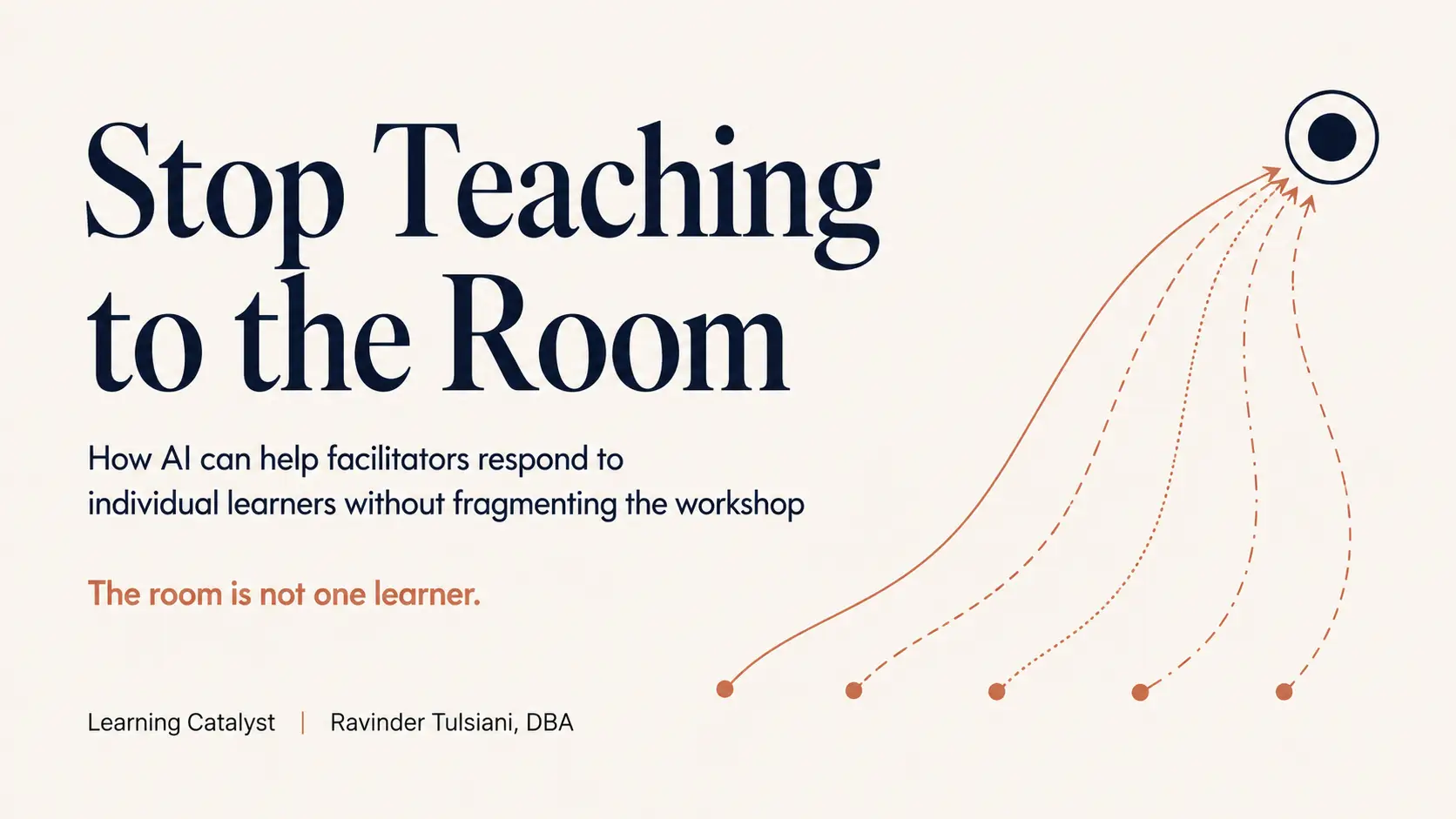
How AI can help facilitators respond to individual learners without fragmenting the workshop
Twenty minutes into a workshop, the differences between participants start to show.
One table has finished the exercise and is waiting. Two tables are working at roughly the expected pace. Another table is still trying to understand the instructions.
The facilitator now has three choices.
Move on and leave some people behind. Pause and frustrate the people who are ready. Add another explanation and hope it solves the problem without creating a new one.
Most experienced facilitators recognize this moment. They also know there is no perfect response.
If they consistently cater to faster learners, novices struggle to keep up. If they teach to the middle, advanced participants lose interest while slower participants may still need more help. If they slow the session down, much of the room begins to disengage.
We often treat this as a facilitation problem. The facilitator needs to read the room better, adjust the pace, change the activity, or provide another example.
Those practices help, but they do not remove the underlying constraint.
A facilitator can change the pace of the workshop. They cannot give thirty people thirty different paces while personally leading the same session.
AI may finally give us a practical way to address that constraint.
Adaptive facilitation currently operates at the room level
Adaptive facilitation is already an established practice. It generally refers to a facilitator’s ability to adjust a session based on who is present and what participants appear to need.
A facilitator may change an example, shorten an activity, spend more time on a difficult point, reorganize groups, or abandon part of the plan when the session is not working.
That is good facilitation.
The limitation is that most adaptations still affect the whole room.
When the facilitator slows down, everyone slows down. When the facilitator offers another explanation, everyone hears it. When the facilitator skips a basic activity, every participant moves ahead whether they were ready or not.
The delivery adapts, but the group remains the unit of instruction.
That is the assumption we need to challenge.
A workshop may be delivered to a group, but learning does not occur at the group level. Each participant interprets the material through their own experience, knowledge, confidence, misconceptions, and job context.
The room is not one learner.
Respecting adults does not mean assuming equal readiness
Adult learning principles encourage facilitators to respect participants’ experience, autonomy, and ability to direct their own learning.
That principle is sometimes applied too casually.
Respecting an adult learner does not mean assuming that the person has all the prerequisite knowledge needed for a particular task. It does not mean removing structure before the learner is ready to work without it. It certainly does not mean leaving a novice to struggle because the facilitator does not want to appear patronizing.
Andragogy tells us to respect the adult learner. It does not give us permission to abandon the novice.
Adults entering the same workshop can differ substantially.
In a workshop on performance conversations, one manager may be preparing for their first difficult conversation. Another may have managed people for ten years but still confuses facts with assumptions. A third may understand the process yet avoid direct conversations because they lack confidence. A fourth may already be capable and need practice with complex cases involving accommodation, conflict, or incomplete information.
Calling one person a novice and another an expert does not fully capture the problem. A participant can be strong in one part of the task and weak in another.
The experienced manager may open a conversation well but fail to ask useful diagnostic questions. The new manager may understand the policy but struggle to respond when an employee becomes defensive.
The facilitator does not need a general label for each participant. The facilitator needs to know where each person requires support.
What AI changes
AI allows us to separate two elements that have traditionally been tied together:
- The experience the group shares
- The support each individual receives
The group can still examine the same business problem, observe the same demonstration, discuss the same standards, and complete the same final performance challenge.
Individual participants can receive different explanations, examples, practice, feedback, or levels of difficulty along the way.
A novice might ask an AI assistant to explain a step in plain language.
Another participant might receive feedback showing where their reasoning went wrong.
An advanced participant might receive a harder scenario instead of completing more versions of an exercise they have already mastered.
Someone who understands the material but lacks confidence might privately rehearse a conversation before attempting it with a partner.
The workshop remains collective. The support becomes personal.
I use the term AI-enabled adaptive facilitation to describe this expanded approach:
A shared learning experience in which participants work toward the same performance standard while receiving different support based on their individual readiness and performance.
The aim is not to create a separate curriculum for every person. That would be difficult to manage and would weaken the social value of the workshop.
The aim is to stop forcing every participant to take the same route at the same speed.
One standard, multiple pathways
A useful adaptive workshop can be designed around five decisions.
1. What must every participant be able to do?
Start with the performance that matters outside the workshop.
“Understand the performance management process” is too vague.
“Conduct a conversation that identifies the performance gap, clarifies the required standard, explores the cause, and agrees on a next action” gives the facilitator something observable.
This standard should remain consistent across the room.
Participants may require different amounts of explanation or practice to reach it. They should not receive a weaker standard because they began with less experience.
Personalization should change the support, not the destination.
This also prevents adaptive learning from becoming a collection of disconnected activities. Every branch should lead back to the performance participants need on the job.
2. Where does each participant need support?
A short pre-workshop diagnostic can reveal more than a general question about experience.
Give participants a realistic scenario. Ask them what they would do, why they would do it, and what information they would need before acting.
Their responses can reveal specific gaps:
- Missing prerequisite knowledge
- Incorrect assumptions
- Weak judgment
- Low confidence
- Difficulty applying the process
- Readiness for more complex work
AI can help analyze these responses and prepare a readiness map for the facilitator.
The map should focus on parts of the performance rather than placing each person into a fixed category.
For example:
| Performance component | Current indication | Likely support |
| Identifying the performance gap | Strong | Standard practice |
| Separating facts from assumptions | Inconsistent | Corrective feedback |
| Exploring possible causes | Limited | Guided questions |
| Handling employee resistance | Untested | Rehearsal |
| Selecting the next action | Strong | More complex scenarios |
This gives the facilitator something more useful than “beginner,” “intermediate,” or “advanced.”
It also avoids relying only on self-reported confidence. Confidence and competence are not the same thing.
3. What should everyone experience together?
Personalization should not dismantle the workshop.
Some parts of the session belong to the group:
- The performance problem
- The organizational standard
- Facilitator demonstrations
- Discussion of competing approaches
- Peer observation and feedback
- Decisions that require collective interpretation
- Final practice under realistic conditions
These are the points where participants develop common language and learn from perspectives other than their own.
A workshop where everyone spends the day in a private conversation with an AI assistant is not adaptive facilitation. It is individualized online learning conducted in the same room.
The facilitator should protect the parts of the experience that depend on dialogue, comparison, disagreement, and human judgment.
4. Where should the pathways separate?
The pathways should separate when individual differences begin to obstruct progress.
There are several common forms of adaptive support.
A participant who lacks basic knowledge may need a short explanation, a worked example, or a step-by-step guide.
A participant who made a reasoning error may need feedback on that error and another attempt with a similar problem.
A participant who is progressing normally may need no additional intervention.
A participant who has already demonstrated the skill may need a more ambiguous case, less information, competing priorities, or a difficult stakeholder.
A participant who lacks confidence may need private rehearsal before performing in front of others.
This support should be available at the point of need. It should not require the facilitator to stop the entire session every time one person requires help.
For example, an AI assistant grounded in the workshop materials could offer prompts such as:
- “Explain this step using an example from my role.”
- “Show me where my reasoning went off track.”
- “Give me another case focused on this skill.”
- “Make the scenario more difficult.”
- “Act as the employee so I can practise the conversation.”
- “Give me feedback using our performance standard.”
The AI is not designing a new workshop in real time. It is selecting from approved forms of support that the facilitator has already defined.
That distinction is important. Unrestricted AI assistance may produce advice that conflicts with policy, introduces incorrect information, or makes the task easier in ways that undermine learning.
The adaptive choices need boundaries.
5. When should everyone rejoin?
Individual pathways should be short.
After receiving support or additional challenge, participants should return to a common task where they must demonstrate the required performance.
These convergence points allow the facilitator to see whether the intervention worked.
They also preserve the integrity of the workshop. Participants may take different routes, but they repeatedly return to shared discussion, practice, and assessment.
In the performance conversation workshop, participants might receive different support while preparing their approach. They would then rejoin for a paired role-play based on the same performance criteria.
A participant who received foundational help still has to conduct the conversation.
A participant who completed an advanced scenario still has to demonstrate the core standard.
The adaptive pathway prepares the person for the performance. It does not replace it.
The facilitator needs intelligence too
Most discussions about personalized learning focus on what AI provides to the learner. The facilitator also needs better information.
Suppose ten participants privately ask the AI assistant for help distinguishing facts from assumptions.
That is no longer an individual learning issue. It is a signal that the facilitator should stop the activity and address the concept with the room.
This leads to a useful decision rule:
Use individual support when the difficulty belongs to one learner. Intervene with the group when the pattern appears across the room.
A facilitator view might show:
- How many participants requested help with each step
- Which misconceptions are recurring
- Where participants are making repeated errors
- Which learners are ready for harder practice
- Which parts of the activity are taking longer than expected
The facilitator does not need access to every private conversation. In most settings, aggregated patterns will be more useful and less intrusive.
AI provides the signal. The facilitator decides what it means and what to do next.
A workshop example
Consider a workshop for new and experienced managers.
The required performance is to conduct an effective conversation about an employee’s repeated missed deadlines.
The facilitator introduces the scenario and asks everyone to prepare an approach.
One participant does not understand the difference between a performance issue and misconduct. The AI assistant provides a brief explanation based on the organization’s policy.
Another participant immediately recommends discipline. The assistant asks what evidence supports that conclusion and what information is still missing.
An experienced manager completes the basic analysis quickly. The assistant adds a new constraint: the employee says the deadlines conflict with requests from another director.
A fourth participant knows what to say but feels uncomfortable beginning the conversation. They rehearse the opening privately with the assistant.
While participants work, the facilitator sees that many are moving too quickly to solutions without investigating the cause. The facilitator pauses the room, asks two participants to share their reasoning, and leads a discussion about diagnosis before action.
Participants then complete paired role-plays using the same evaluation criteria.
The room did not move at one pace. It still moved toward one standard.
The failure modes
AI-enabled adaptive facilitation will not work simply because participants have access to a chatbot.
Poor implementation can make the workshop worse.
The first risk is fragmentation. Too much individual activity can weaken discussion and peer learning. Adaptive support should be brief and connected to the shared task.
The second risk is over-support. Learners need time to think, make mistakes, and struggle with difficult decisions. AI should not provide an answer every time a participant hesitates.
The third risk is unreliable guidance. The assistant should use approved policies, examples, processes, and performance standards. A general-purpose chatbot should not improvise advice in regulated or high-risk settings.
The fourth risk is false diagnosis. A short assessment cannot reveal everything about a learner. The readiness map is an initial hypothesis that should change as the facilitator observes actual performance.
The fifth risk is privacy. Participants need to know what information is visible to the facilitator, what is stored, and how it will be used.
These are design constraints, not reasons to preserve a weaker model.
A practical test before adding AI
Before introducing AI into a workshop, answer these questions:
- What performance must every participant demonstrate?
- Which differences between participants interfere with that performance?
- What parts of the workshop require a shared experience?
- What individual support would help without removing productive struggle?
- How will participants return to a common performance task?
- What information does the facilitator need during the session?
If the design team cannot answer those questions, AI will probably add novelty rather than capability.
Stop looking for the perfect pace
Facilitators have spent years trying to solve learner variability through pacing.
They slow down, speed up, add optional exercises, rearrange groups, ask stronger participants to help others, and improvise explanations when people become confused.
Those methods remain useful. They are no longer enough.
There is no pace that is right for every person in the room.
The better solution is to keep one performance standard while allowing participants to receive different support on the way to meeting it.
That is the opportunity AI creates for in-person learning.
The facilitator still leads the room. Participants still learn from one another. The workshop still produces a shared understanding of capable performance.
What changes is the assumption that respect for the group requires us to teach everyone as though they were the same learner.
They are not.