People go through the training.
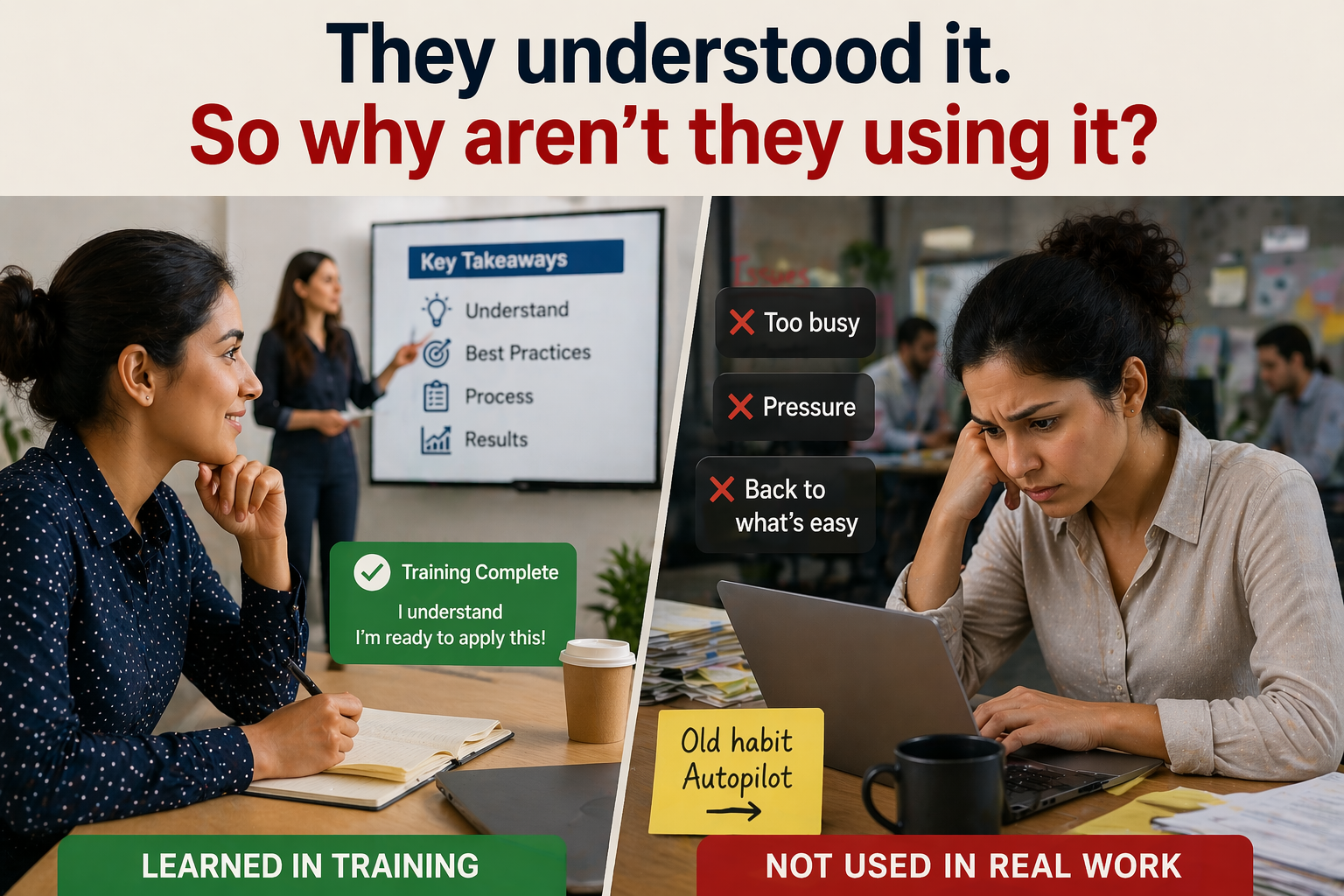
They understand it.
They even agree with it.
But when it comes time to use it, nothing really changes.
They go back to what they’ve always done.
This is often seen as a motivation issue.
But in most cases, it isn’t.
People aren’t refusing to apply what they learned.
They’re defaulting to what feels easier, faster, or more certain in the moment.
Because real work doesn’t happen in ideal conditions.
It happens:
- under time pressure
- with incomplete information
- while juggling multiple priorities
And in those moments, people don’t stop to think through what they learned.
They rely on instinct.
If training doesn’t match those conditions, it creates a gap.
People may understand the right approach.
But they’ve never had to use it:
- without guidance
- under pressure
- when the outcome isn’t obvious
So when the moment comes, they hesitate—or revert.
What looks like “they’re not applying it” is usually this:
They were never prepared to act on it in real situations.
If people aren’t applying what they learned, a few questions help clarify why:
- What should they actually be doing differently on the job?
- When does that behaviour need to happen?
- What makes that moment difficult (pressure, time, uncertainty)?
- Did the training reflect that situation—or simplify it?
- Did they have to make decisions themselves, or just follow along?
If those conditions weren’t part of the training, application will always be inconsistent.
People don’t apply training because they don’t need information.
They need to be prepared to act.
Where this leads
If the goal is behaviour change, training has to go beyond explaining what to do.
It has to prepare people to make the right decisions when it actually matters.
That’s what determines whether learning translates into performance.
That shift—from understanding to execution—is the focus of Training That Actually Works.