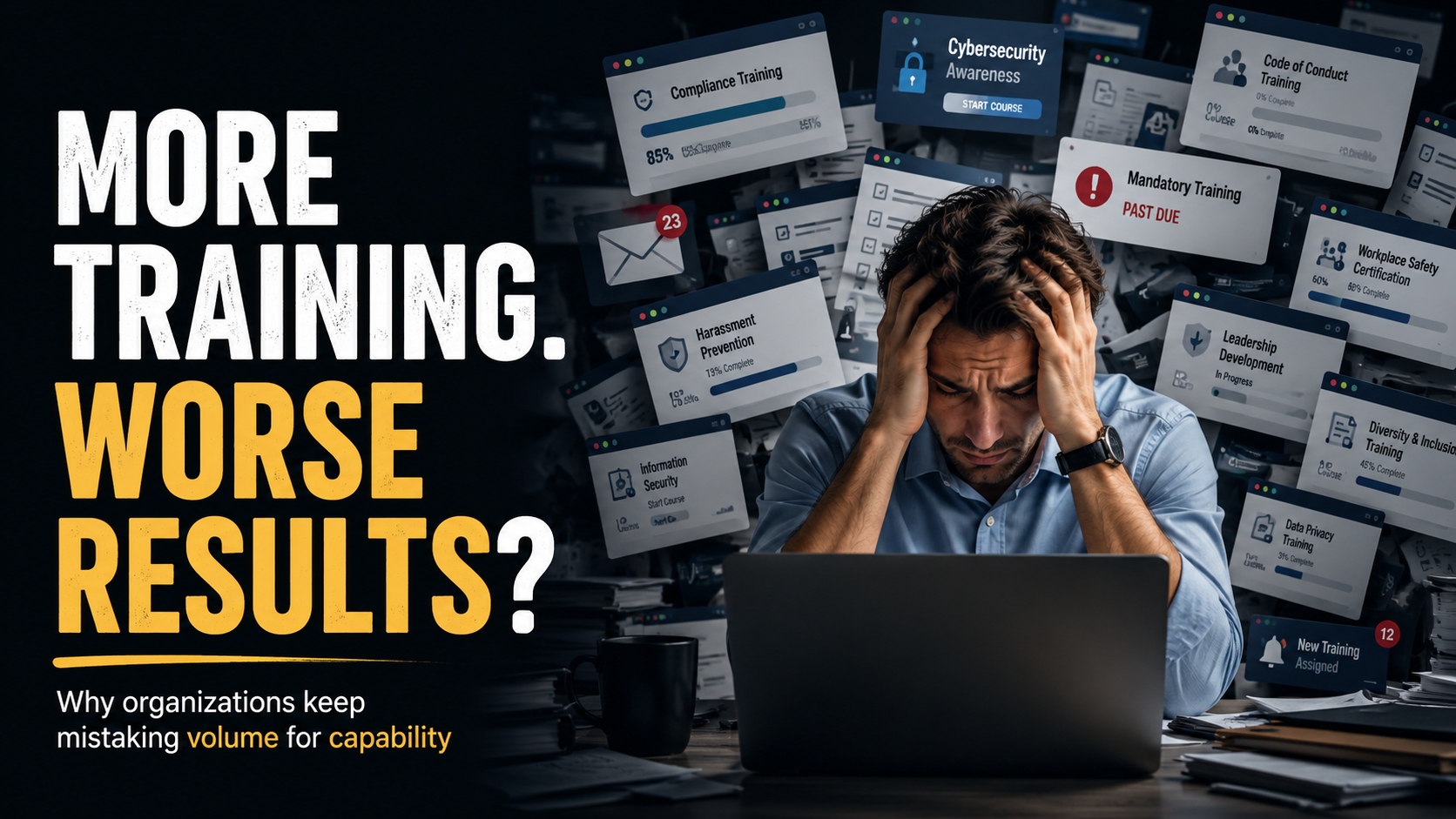
Organizations often say they want to scale learning.
What they usually build is bureaucracy.
More intake forms. More approval layers. More steering committees. More custom programs. More dashboards reporting activity. More centralized control over work that the business should partly own.
The result is predictable: demand for learning increases, but the learning function becomes slower.
This is the scaling trap.
The problem is not that L&D teams lack effort. Most are working extremely hard. The problem is that many organizations try to scale learning by expanding the same operating model that already creates friction. They centralize more decisions, produce more content, add more governance, and call it maturity.
But scaling L&D should not mean building a larger production department.
It should mean building an organization that can develop capability faster, closer to the work, with less dependence on L&D for every decision.
The real question is not “How do we deliver more training?”
That question leads to volume.
More courses. More modules. More completions. More content libraries.
A better question is:
How do we increase capability without increasing complexity?
That question leads to an operating model.
This distinction matters because completion is not capability. Exposure is not execution. A polished course does not guarantee better judgment, better decisions, or better performance under pressure.
Training only matters when it improves what people do when it counts.
If learning does not change performance, scaling it only scales activity.
Why L&D becomes bureaucratic
Bureaucracy usually appears when organizations confuse control with quality.
A stakeholder asks for training. L&D opens an intake process. A review meeting is scheduled. A designer is assigned. A course is scoped. SMEs are gathered. Approvals begin. By the time the solution launches, the original business problem may have shifted.
The process looks responsible.
But it often protects the system more than it improves the work.
L&D bureaucracy usually grows from five habits:
- Centralizing too much execution
- Treating every request as a custom project
- Using approvals instead of decision rules
- Measuring learning activity instead of business movement
- Scaling content instead of capability
The alternative is not chaos.
It is disciplined decentralization.
The SCALE Model
To scale L&D without bureaucracy, the operating model has to change.
I use a simple frame:
S — Standardize the rules
C — Clarify ownership
A — Architect reusable products
L — Locate support in the workflow
E — Evidence business movement
This is not a maturity model.
It is a practical operating discipline.
S — Standardize the rules
L&D should not own every learning action in the organization.
It should own the rules that make learning consistent, useful, and measurable.
That means centralizing:
- standards
- templates
- capability frameworks
- measurement logic
- platform governance
- quality rules
- data visibility
And decentralizing:
- local examples
- manager reinforcement
- SME contribution
- workflow application
- contextual adaptation
The principle is simple:
Standardize the rules. Decentralize the work.
This is where L&D moves from content creator to capability architect — a shift that becomes even more important as AI and workflow tools change how employees access knowledge and support.
C — Clarify ownership
A common reason L&D becomes overloaded is that every performance issue gets handed to learning.
But L&D cannot own every condition required for performance.
Managers own reinforcement.
Leaders own priority.
Operations owns workflow.
Compliance owns policy interpretation.
Technology owns systems.
L&D owns capability design, enablement architecture, and measurement discipline.
Before accepting a learning request, apply a simple tool:
The Capability Filter
1. Problem — What business issue exists?
2. Performance — What behavior or decision must change?
3. Cause — Why is this actually a capability issue?
4. Evidence — What business signal should move?
5. Dose — What is the minimum effective intervention?
If those answers are unclear, do not build.
Pause. Diagnose. Redirect.
Sometimes the answer is a checklist. Sometimes it is a manager conversation guide. Sometimes it is a workflow change. Sometimes it is coaching. Sometimes it is training.
The point is not to avoid training.
The point is to stop using training as the default response to every performance issue.
A — Architect reusable products
Projects do not scale well.
Products do.
A project ends. A product improves.
Instead of building one-off programs, L&D should create reusable assets such as:
- onboarding playbooks
- manager toolkits
- compliance decision guides
- leadership practice labs
- role-based capability pathways
- AI prompt libraries
- performance support kits
Each product should have:
- an owner
- a target audience
- a use case
- an update cycle
- a success metric
- a reuse strategy
Ask this before building anything:
Can this be reused, adapted, or repurposed at least ten times?
If not, be careful before investing heavily.
In large-scale environments, the breakthrough is rarely “more learning.”
In one environment supporting 60,000+ learners, the shift came not from building more courses, but from creating reusable pathways, clearer governance, platform discipline, and stronger manager ownership. The goal was not to centralize everything. It was to make local execution faster without sacrificing consistency.
That is how scale happens without multiplying bureaucracy.
L — Locate support in the workflow
Courses are often too far away from performance.
Employees need help when they are making decisions, handling conversations, using systems, serving clients, managing risk, or solving problems.
That means more:
- job aids
- checklists
- decision trees
- scripts
- manager prompts
- workflow nudges
- searchable knowledge
- AI-supported practice
- scenario-based rehearsal
This is not “less learning.”
It is learning placed where performance actually happens.
People do not perform better simply because they have seen more content.
They perform better when the right support appears close enough to the moment of need to change the decision.
E — Evidence business movement
A bureaucratic learning function reports what is easy to count:
- attendance
- completions
- satisfaction
- course volume
- hours delivered
A strategic learning function reports what matters:
- time to competence
- adoption
- error reduction
- quality improvement
- compliance risk reduction
- productivity lift
- manager effectiveness
- retention
- customer or patient outcomes
Executives do not fund learning because people completed modules.
They fund learning when capability helps the organization perform.
This is the credibility shift: L&D must move from reporting activity to demonstrating contribution.
Where AI fits
AI can absolutely help L&D scale.
But only if it improves the operating model.
If AI is used primarily to create more courses faster, it may simply accelerate the wrong system.
The better use of AI is to reduce friction:
- analyze requests faster
- draft role-based scenarios
- create manager guides
- personalize practice
- summarize learner feedback
- generate job aids
- support content maintenance
- identify patterns in performance data
AI should not be used to industrialize course production.
It should be used to industrialize clarity:
- better diagnosis
- faster scenario design
- cleaner manager tools
- stronger performance support
- smarter reuse
- clearer capability pathways
AI should not make L&D a faster content factory.
It should help L&D become a better capability system.
The value is not speed alone.
The value is better structure, better diagnosis, better reuse, and better support closer to the work.
Use tiered governance
No scaling model works without governance.
But governance should be proportionate.
Not every request deserves the same level of control.
A practical model:
Tier 1: Self-Serve
Low-risk, local, repeatable needs. Use templates, checklists, and standards.
Tier 2: Guided
Moderate-risk or cross-functional needs. L&D advises, reviews, and supports.
Tier 3: Enterprise-Critical
High-risk, strategic, regulatory, transformation, or executive-priority initiatives. L&D leads formal design, governance, and measurement.
This prevents small requests from being over-governed and important work from being under-governed.
Good governance should accelerate the right work and stop the wrong work.
A simple test
Look at your current L&D operating model and ask:
When demand increases, do we add more:
- meetings?
- approvals?
- custom builds?
- intake steps?
- reporting decks?
- central bottlenecks?
Or do we increase:
- reuse?
- manager ownership?
- self-service quality?
- performance support?
- decision clarity?
- business accountability?
The first path scales bureaucracy.
The second path scales capability.
What to do Monday morning
Pick one recurring learning request category:
onboarding, compliance refreshers, manager training, system training, or role-based enablement.
Then do four things:
1. Apply the Capability Filter
2. Convert one recurring program into a reusable product
3. Define which requests are self-serve, guided, or enterprise-critical
4. Replace at least one course component with a performance-support tool
Then measure one business signal, not just completion.
That is how the shift starts.
Not with a transformation announcement.
Not with a new maturity model.
Not with another platform.
With a better decision about what L&D should own, what the business should own, and what should never become training in the first place.
The final point
The goal is not to make L&D smaller.
The goal is to make L&D less dependent on heroic effort.
A mature learning function does not prove its value by saying yes to every request.
It proves its value by helping the organization build capability with less friction, less waste, and more evidence of impact.
Because the future of L&D is not more content.
It is better systems for performance.
If scaling learning requires more bureaucracy, you are not scaling learning. You are scaling the wrong operating model.