Why organizational culture, leadership behaviour, and daily work practices shape workforce capability more than formal training.
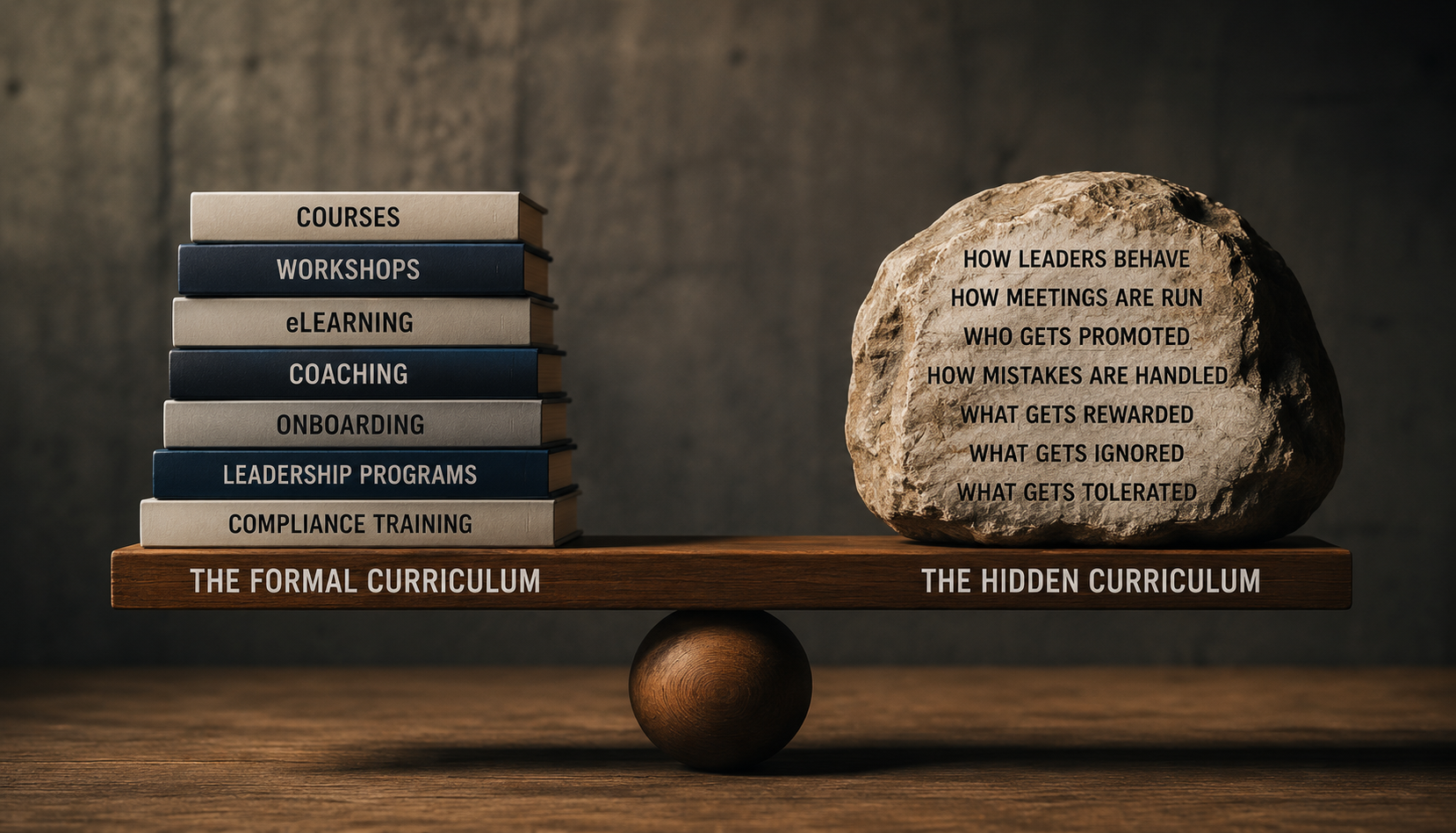
Every organization has two curricula.
The first is easy to see.
It includes courses, workshops, eLearning, coaching, onboarding, leadership programs, and compliance training. It has budgets, calendars, facilitators, learning objectives, and completion reports.
This is the formal curriculum.
The second curriculum rarely appears on an organizational chart.
It isn’t documented in a course catalogue or managed through a learning management system.
Yet employees experience it every day.
It is how leaders behave.
How meetings are run.
Who gets promoted.
How mistakes are handled.
What gets rewarded.
What gets ignored.
What gets tolerated.
This is the hidden curriculum.
And in most organizations, it is the stronger of the two.
Consider a simple example.
An organization launches a leadership development program focused on coaching, psychological safety, and employee development.
Participants leave energized. They understand the models, practise the conversations, and commit to applying what they learned.
The following Monday, they attend a leadership meeting.
The executive who sponsors the program interrupts people, dismisses opposing views, praises leaders who deliver short-term results regardless of how they achieved them, and publicly criticizes mistakes.
Which curriculum do you think employees will believe?
The workshop?
Or what they just observed?
Training communicates expectations.
Culture communicates reality.
Employees almost always believe reality.
This is one of the most overlooked reasons learning initiatives fail to produce lasting business impact.
Organizations often assume the problem lies within the learning solution.
Perhaps the content wasn’t engaging enough.
Perhaps the facilitator wasn’t effective.
Perhaps more reinforcement is needed.
Sometimes those explanations are correct.
But sometimes the organization is trying to solve the wrong problem.
The hidden curriculum has simply overwhelmed the formal one.
If collaboration is taught but individual competition is rewarded, employees learn competition.
If innovation is encouraged but failure is punished, employees learn risk avoidance.
If coaching is celebrated in training but promotions favour technical expertise alone, employees learn where the organization truly places value.
None of these lessons appear in the training materials.
Yet they become the organization’s most powerful learning experiences.
This is why workforce capability cannot be built through training alone.
Capability develops through the interaction of learning, leadership, systems, incentives, processes, and culture.
Training is one influence.
The environment determines whether that influence grows or disappears.
This distinction becomes even more important as organizations invest in artificial intelligence.
Many organizations are creating AI strategies, AI literacy programs, and AI policies.
Those are all part of the formal curriculum.
But employees are watching something else.
What happens when someone experiments with AI?
Are they recognized for improving the way work gets done?
Or criticized for making an honest mistake?
Do leaders use AI themselves?
Or do they quietly expect everyone else to?
Are people rewarded for thoughtful experimentation?
Or only for maintaining the status quo?
These questions determine an organization’s AI readiness far more than a single training program ever will.
The same principle applies across every major organizational initiative.
You cannot build a customer-centric culture while rewarding only internal efficiency.
You cannot create accountability while leaders consistently avoid difficult conversations.
You cannot develop collaboration while performance systems reward individual heroics.
And you cannot build workforce capability if the organization teaches one thing in the classroom and another through everyday experience.
This is why I believe one of the most important responsibilities of today’s learning leaders is not simply designing better learning.
It is diagnosing the hidden curriculum.
Before asking,
“How do we improve the training?”
Ask,
“What is our organization teaching every day without realizing it?”
That question often reveals far more than another needs assessment.
It shifts the conversation from learning interventions to organizational conditions.
From content to culture.
From events to systems.
From delivering training to building capability.
The strongest learning organizations understand a simple truth.
People do not learn only from what we teach.
They learn from what they repeatedly experience.
Formal learning introduces new ideas.
The hidden curriculum determines whether those ideas survive.
As learning leaders, we should certainly continue improving courses, workshops, coaching, and digital learning.
But we should also spend just as much time examining leadership behaviour, organizational systems, incentives, decision-making, and workplace culture.
Because every organization has two curricula.
Only one of them is teaching every minute of every day.
Reflection
Before approving your next learning initiative, ask five questions:
- What behaviours do leaders consistently model?
- What gets rewarded in practice?
- What behaviours are quietly tolerated?
- What lessons do employees learn from everyday decisions?
- If every training program disappeared tomorrow, what would employees still learn from working here?
The answers reveal your hidden curriculum.
And your hidden curriculum may be the most influential learning system your organization has.
Dr. Ravinder Tulsiani is a Workforce Capability and AI Readiness Advisor. Through L&D Simplified, he helps learning leaders think more clearly, diagnose more accurately, and make better capability decisions in an AI-enabled world.