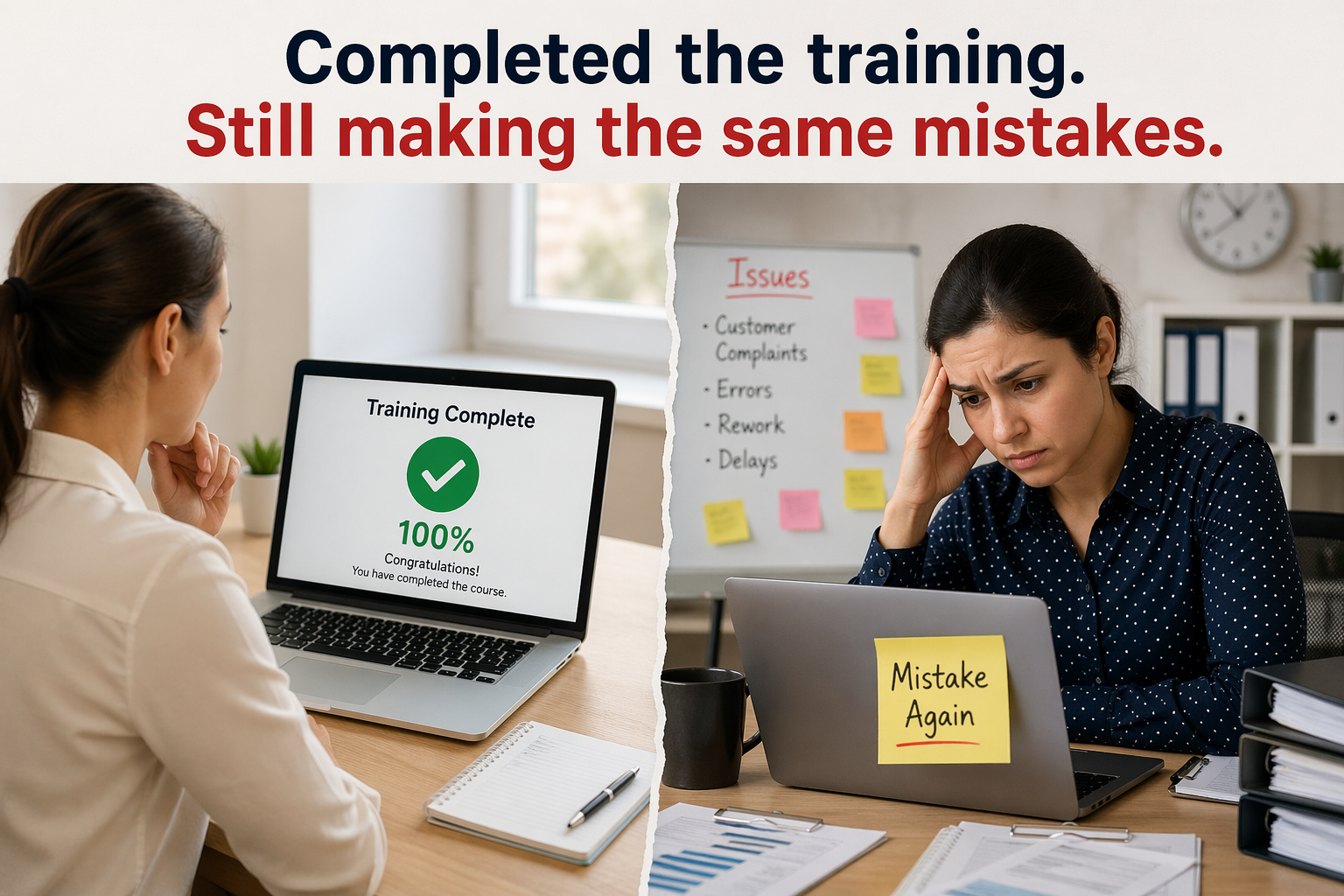
People complete the training.
They pass the assessment.
They say it was clear.
And then, back at work, the same mistakes keep happening.
This is one of the most common frustrations in organisations—and one of the hardest to fix.
In most cases, the issue is not that people didn’t understand the material.
It’s that the training didn’t prepare them for the conditions they actually face on the job.
Training environments are usually structured, predictable, and low pressure.
Real work is different.
It’s fast.
It’s messy.
It’s interrupted.
And sometimes, there’s no time to stop and think.
People don’t fail because they forgot everything.
They fail because they can’t apply it when those conditions show up.
There’s a difference between recognizing the right answer in training and producing the right action in real work.
Most training focuses on the first.
Performance depends on the second.
This is where things start to break down.
When training is designed to explain rather than prepare, people leave with knowledge—but not necessarily with the ability to act on it.
So when the real situation happens, they hesitate.
They default.
Or they fall back into old patterns.
And the same mistakes show up again.
If this is happening, a few questions usually make the issue clearer:
- What should people actually be doing differently on the job?
- Where does the mistake happen in real work?
- What’s happening in that moment—pressure, time, ambiguity?
- Did the training prepare them for that situation, or just explain it?
- Did they ever have to make the decision themselves during training?
If those answers aren’t clear, the problem isn’t participation.
It’s design.
Training that changes behaviour isn’t built around content alone.
It’s built around the moments where performance actually breaks down—and preparing people to handle those moments properly.
That’s the difference between training that works in theory and training that holds up in real work.
Where this leads
If training is meant to improve performance, then it has to be designed for the conditions where performance is tested—not just the environment where learning happens.
That shift—away from content coverage and toward real-world performance—is the focus of Training That Actually Works.