I keep coming back to one question as AI becomes more capable:
If AI can increasingly perform cognitive work itself, what must humans remain responsible for?
That question changes the conversation for Learning & Development.
For years, L&D has focused on what people need to know, what skills they need to build, and how learning can improve performance.
But AI is starting to change the work itself.
It can increasingly retrieve information, analyze data, generate recommendations, produce professional work, and support decisions that previously depended heavily on human expertise.
So the issue is no longer simply:
What should people learn?
It is also:
What should AI perform?
What should humans still decide?
What must humans be able to verify?
Where must humans retain authority?
What expertise cannot be allowed to disappear?
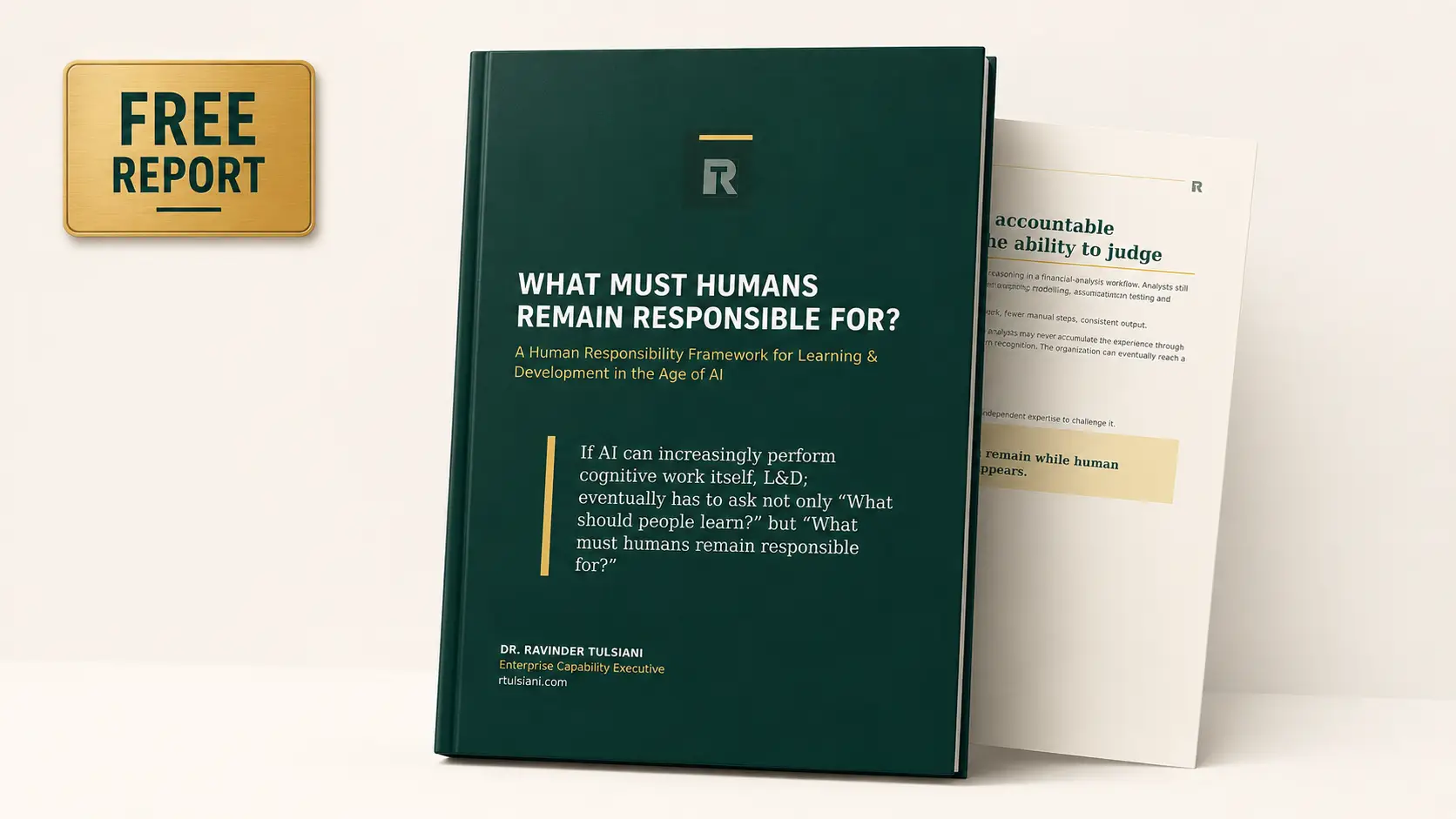
I explored these questions in a new research report:
What Must Humans Remain Responsible For?
A Human Responsibility Framework for Learning & Development in the Age of AI
One finding became particularly important as I worked through the research.
I call it the Oversight Paradox:
Humans can remain formally accountable after becoming practically incapable of exercising the judgment that accountability requires.
Imagine AI performs most of the analysis, generates the recommendation, and produces the final work.
A human still clicks “approve.”
Technically, there is a human in the loop.
But if that person no longer has the expertise, authority, time, or practice required to challenge the AI, meaningful oversight may already be gone.
That creates a different challenge for L&D.
We may need to stop thinking only about building new skills and start thinking about protecting the human capability required to govern increasingly capable machines.
The report introduces a practical Human Responsibility Framework to help organizations decide:
- what AI should perform
- what humans should continue to own
- what level of human control is required
- what minimum human capability must be preserved
- where automation could create capability atrophy
- how L&D should respond
The principle behind the framework is simple:
Automate capability freely. Delegate responsibility deliberately.
And the corresponding challenge for L&D is just as important:
Build and protect the human capability required to make that responsibility real.
I’ve made the full research report available as a free download.