AI Literacy in the Age of Intelligent Agents — Part 1 of 4
This article is part of a four-part series on AI literacy in the age of intelligent agents. The series explores why traditional approaches to AI training fall short—and what organizations must do differently to build real capability.
The leadership team moves quickly.
They approve AI pilots. They encourage teams to experiment. They ask Learning and Development to “get something in place.” Within weeks, employees have access to tools, training sessions are scheduled, and early use cases begin to surface.
From the outside, progress is visible.
From the inside, it is uneven.
Some teams move fast. Others hesitate. Some employees use AI constantly. Others avoid it altogether. Leaders sense momentum—but struggle to connect it to meaningful performance improvement.
This pattern is not unusual.
It reflects a deeper shift that many organizations have not yet fully absorbed:
AI is no longer a tool adoption issue.
It is becoming a competitiveness issue.
A Different Kind of Inflection Point
For the past two years, most organizations have experienced AI through large language models—tools that respond to questions, generate content, and assist with knowledge work.
That phase is ending.
A new phase is emerging: AI that executes.
Instead of answering questions, systems are beginning to complete tasks:
- Drafting and revising complex documents
- Managing workflows and coordination
- Writing and testing code
- Conducting multi-step analysis
- Orchestrating processes across systems
This shift—from assistance to execution—changes the role AI plays inside organizations.
It also changes what is required of the workforce.
The question is no longer:
“Do employees have access to AI?”
It is:
“Can employees use AI in ways that improve the work?”
The Pace of Change Is Not Uniform
This shift is not happening at the same speed everywhere.
Some economies are moving deliberately. Others are moving systematically.
China’s “AI Plus” strategy, for example, is built on the premise that AI will be embedded across the majority of economic sectors—not as an add-on, but as infrastructure. In many industries, advanced forms of AI are already integrated into operations, not isolated in pilot programs.
The implication is not simply technological.
It is organizational.
When AI is embedded at scale, the advantage does not come from access to tools. It comes from how effectively people use them—consistently, safely, and in alignment with the work.
Organizations that delay this transition are unlikely to remain neutral.
They are more likely to fall behind.
The Opportunity Is Larger Than the Risk
Much of the public conversation around AI focuses on job loss.
But that framing is incomplete.
As AI systems begin to execute tasks, they do not simply remove work. They change its structure.
Tasks that once constrained productivity—analysis, drafting, coordination, iteration—are increasingly handled by intelligent systems. What remains—and expands—is the purpose of the role.
Consider healthcare.
A radiologist’s task includes reviewing scans. But the purpose of the role is diagnosis, clinical collaboration, and patient outcomes. When AI accelerates scan analysis, it does not eliminate the role. It increases capacity: more patients, faster decisions, broader impact.
A similar pattern is emerging across knowledge work. In software development, engineering, operations, and professional services, AI is compressing execution time. Teams can experiment more, iterate faster, and pursue problems that were previously out of reach.
In this sense, AI does not simply replace work.
It redistributes it.
The constraint shifts from execution capacity to decision quality.
The Real Risk
If the opportunity is expansion, the risk is misalignment.
Organizations may invest in tools without preparing people for how the work is changing. They may train employees on features without clarifying expectations. They may encourage experimentation without defining boundaries.
Under these conditions:
- Some employees overuse AI
- Others underuse it
- Outcomes become inconsistent
- Risk increases
- Performance becomes harder to manage
The issue is not capability in the traditional sense.
It is clarity.
A Different Starting Point
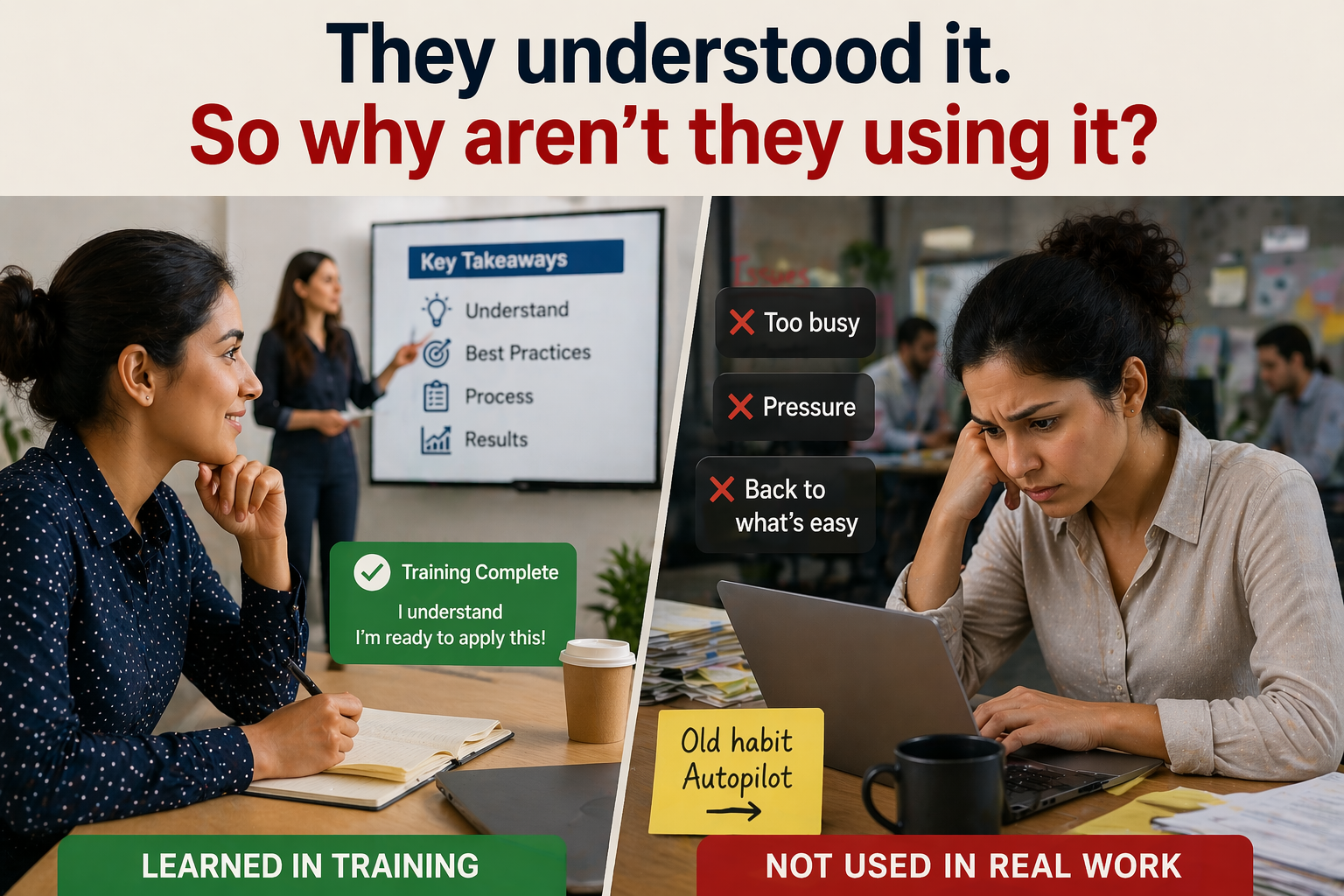
Most organizations approach AI literacy as a training problem.
It is not.
Before capability can be built, three questions must be answered:
- What is AI actually for in this organization?
- Where does it fit within real work and decisions?
- What are employees allowed—and expected—to do?
Without clear answers, training becomes activity.
With them, it becomes leverage.
The Shift Leaders Need to Make
AI literacy is often framed as a technical skill:
How to write prompts
How to use tools
How to increase productivity
But these are surface-level capabilities.
The deeper shift is this:
From using AI to thinking with AI.
From completing tasks
To making better decisions
From executing work
To shaping outcomes
That shift does not happen through access alone.
It requires deliberate alignment between the technology, the work, and the people doing it.
What Comes Next
The challenge most organizations face is not adopting AI.
It is operationalizing it.
And that is where many current efforts fall short.
In the next article, we examine why AI training initiatives often fail before they begin—and how misalignment across perception, context, and permission quietly undermines adoption.
Because the question is no longer whether employees will use AI.
It is whether they will use it well enough to keep the organization competitive.