AI has created both excitement and anxiety inside Learning and Development.
Every week brings another announcement.
New tools.
Faster content creation.
Automated video.
AI-generated assessments.
Course outlines in seconds.
The pressure is growing.
Executives are asking:
“What are we doing about AI?”
L&D teams are asking:
“How do we keep up?”
And vendors are promising the same thing:
Faster development. Faster delivery. Faster learning.
On the surface, this sounds like progress.
But many L&D teams are quietly running into the same problem.
They are working faster.
Yet the work itself is not improving.
Content is still being requested reactively.
Courses are still being built for problems training cannot solve.
Stakeholders still ask for learning when the real issue is workflow, management, systems, or incentives.
The output gets faster.
The frustration stays the same.
Which raises an uncomfortable question:
What if AI is not solving the problem L&D actually has?
There are five reasons many AI efforts inside L&D fail to deliver meaningful impact. But the final one matters most because it explains why faster production often creates more work instead of less.
5. AI Makes Bad Processes Faster
Many L&D teams are approaching AI like this:
“How can we create courses faster?”
Reasonable question.
Incomplete question.
Because speed only matters if the work itself is valuable.
If stakeholders are asking for the wrong solution, AI simply helps you build the wrong thing faster.
A vague request becomes a rapid course.
Weak objectives become faster weak objectives.
Poorly diagnosed performance problems become polished learning assets.
More efficient.
Still ineffective.
AI is powerful.
But faster execution does not fix unclear thinking.
And that exposes a deeper issue many teams are only beginning to notice.
4. Most L&D Teams Are Using AI for Content Instead of Thinking
This is where many AI conversations go sideways.
People focus on:
- writing scripts
- generating quizzes
- creating images
- summarizing articles
- drafting slides
Useful tasks.
But they are not the highest-value work in L&D.
The real value of AI is not replacing effort.
It is improving thinking.
Clarifying stakeholder requests.
Identifying whether training is even needed.
Testing assumptions.
Generating options.
Stress-testing learning strategies.
Helping practitioners think more critically before building.
The question should not be:
How can AI help us build faster?
The better question is:
How can AI help us make better decisions?
Because better decisions reduce unnecessary work long before development starts.
And that matters because another problem is quietly making many L&D teams less effective.
3. AI Is Exposing Weak L&D Workflows
For years, many teams survived through effort.
Someone requested training.
A course was built.
Slides were developed.
Reviews happened.
Revisions followed.
Everyone worked hard.
The process was slow, but familiar.
AI changes the economics of that model.
Content can now be generated in minutes.
Which creates an uncomfortable reality.
If content becomes easier to produce, what exactly creates value in L&D?
The answer cannot be:
“Building slides.”
Or:
“Creating courses.”
Because AI can increasingly assist with both.
The value shifts elsewhere.
Into diagnosis.
Judgment.
Performance consulting.
Capability architecture.
Business alignment.
Measurement.
The strongest L&D professionals will not be the ones who produce content fastest.
They will be the ones who think best.
And that becomes even more important because of another mistake organizations keep making.
2. L&D Is Still Solving Training Problems Instead of Performance Problems
This pattern is everywhere.
A business issue appears.
Someone asks for training.
L&D builds training.
Completion happens.
Very little changes.
AI does not fix this cycle.
In some cases, it accelerates it.
Because when content creation becomes easier, the temptation is to produce more of it.
Faster.
Cheaper.
At scale.
But volume was never the real problem.
Capability was.
Performance was.
Execution was.
If employees already know what to do but still do not do it, the answer may not be training at all.
It may be systems.
Manager reinforcement.
Workflow friction.
Incentives.
Expectations.
Environment.
AI can make course creation dramatically faster.
But it cannot solve the wrong problem.
And even organizations that understand this often miss the biggest shift happening underneath all of it.
1. AI Is Not Changing L&D Because of Speed
This is the part many people misunderstand.
The biggest change AI brings to Learning and Development is not productivity.
It is clarity.
For years, L&D was rewarded for effort.
Building content.
Managing projects.
Creating learning experiences.
Starting from scratch.
AI changes the standard.
When content becomes easier to create, value moves elsewhere.
Toward judgment.
Problem definition.
Performance thinking.
Decision quality.
Better operating models.
The question stops being:
How fast can we build?
And becomes:
Are we solving the right problem in the first place?
This changes everything.
Because the future of L&D does not belong to teams that simply use AI tools.
It belongs to teams that rethink how the work itself gets done.
Teams that move from content production to capability building.
From order takers to strategic partners.
From activity to measurable performance improvement.
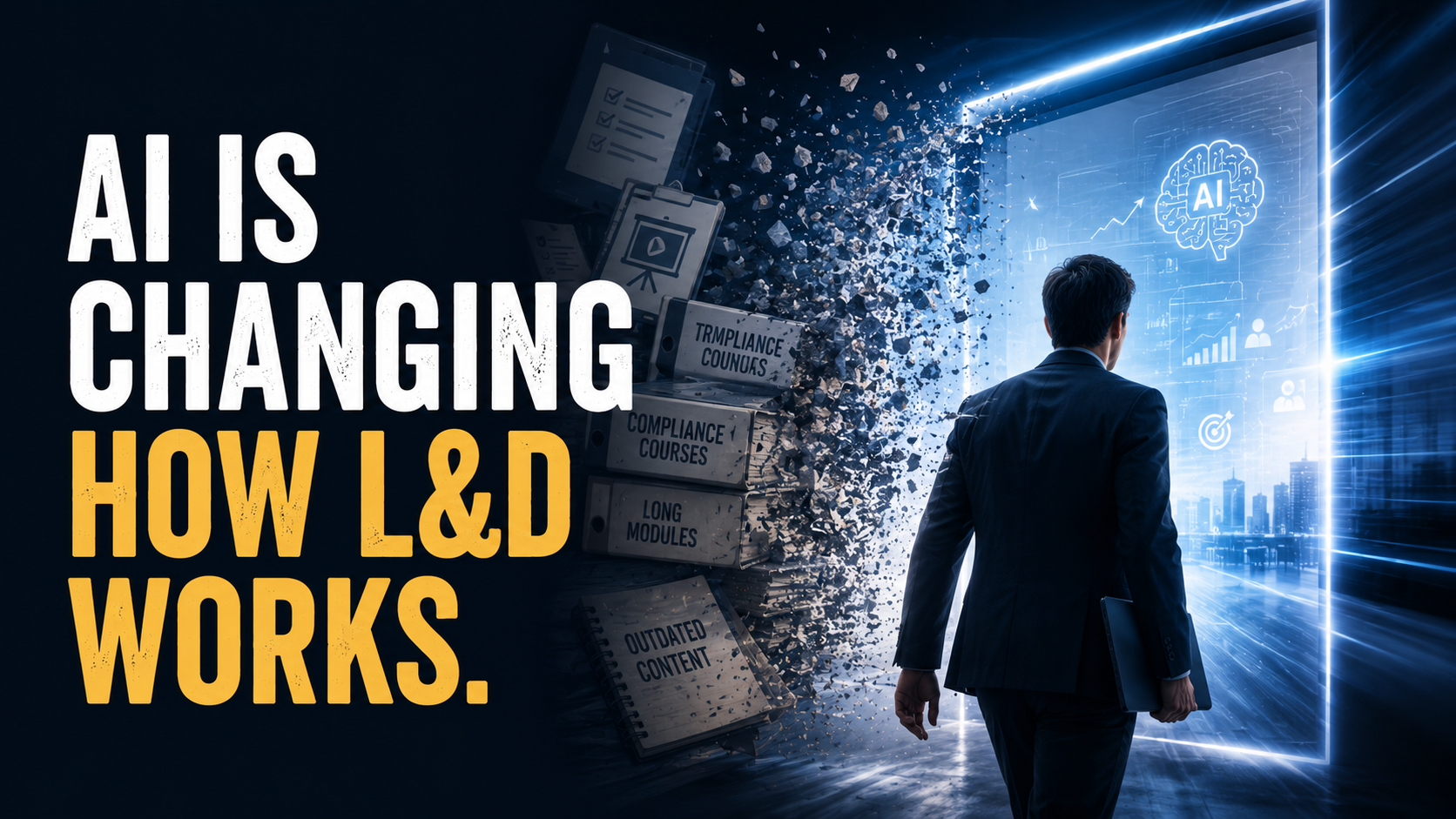
AI is not replacing good L&D.
It is exposing it.
And that is exactly why I wrote AI for Learning & Development.
Not to teach people how to generate more content.
But to help L&D professionals work smarter, make better decisions, and redesign how capability gets built in an AI-enabled world.
Because the biggest opportunity in front of L&D is not moving faster.
It is becoming more valuable.
Being asked to build AI training?
Before you design the course, test whether training is actually the intervention you need. I’m developing a free AI Training Triage to help identify whether the problem points first to training, workflow, role clarity, manager enablement, governance, systems, or further diagnosis.