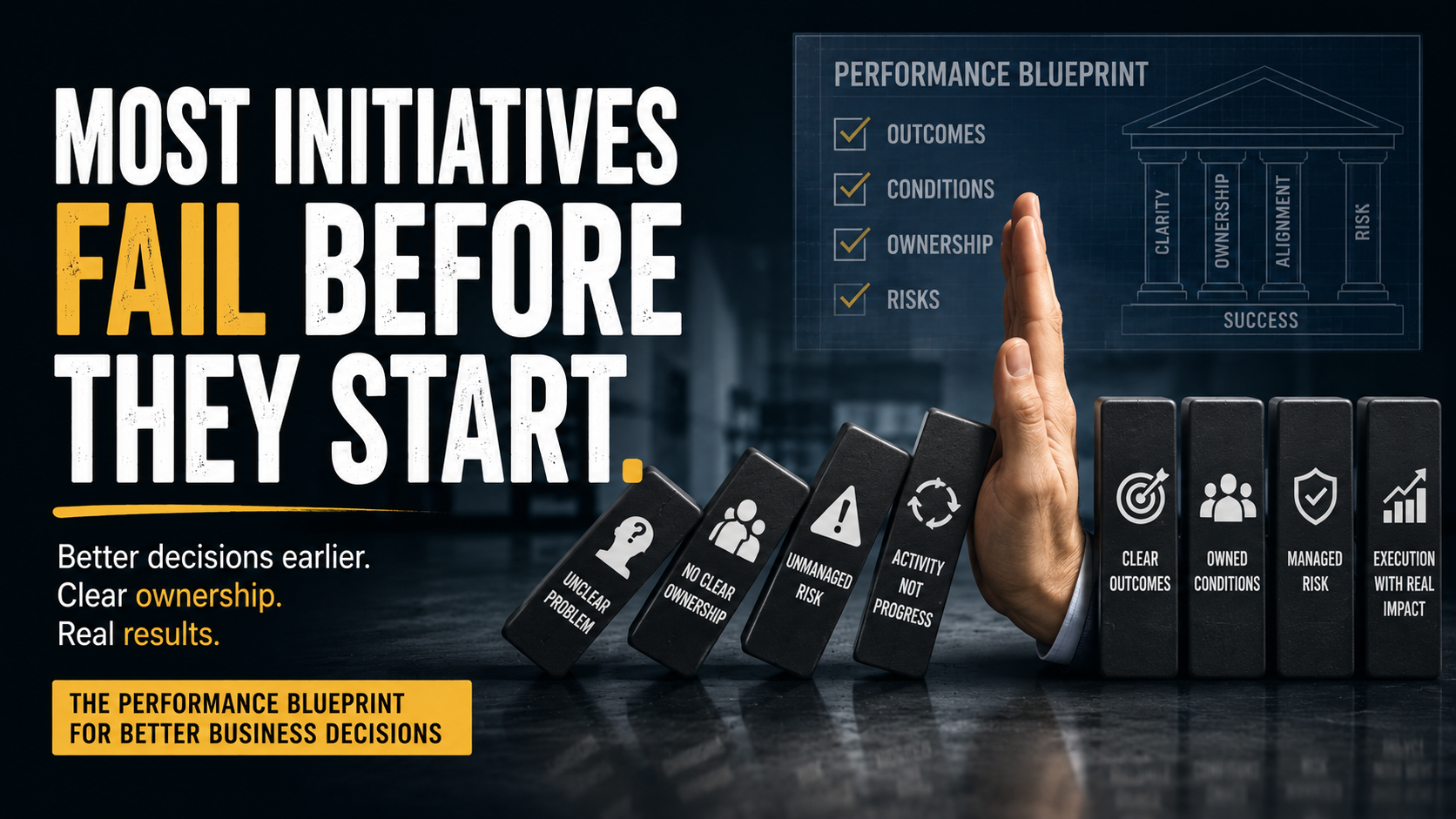
Most organizations think failure happens during execution.
The strategy was weak.
The project team struggled.
Stakeholders resisted change.
Adoption was slow.
Leadership lost focus.
Budget pressure appeared.
The implementation became messy.
Sometimes those things are true.
But many initiatives fail much earlier than leaders realize.
In fact, by the time execution begins, the outcome is often already constrained.
The conditions for success were never fully established.
The assumptions were unclear.
Ownership was vague.
Dependencies remained unresolved.
Risk was acknowledged but never managed.
And everyone moved forward anyway.
Usually with optimism.
Often with momentum.
Sometimes with urgency disguised as confidence.
Which raises an uncomfortable question:
What if many initiatives fail before the work even starts?
There are five predictable reasons this happens. But the final one matters most because it explains why even highly capable teams often struggle to deliver meaningful results.
5. Organizations Start With Solutions Instead of Problems
This pattern is everywhere.
A challenge appears.
The response comes quickly.
“We need training.”
“We need new technology.”
“We need a transformation program.”
“We need a new operating model.”
The solution arrives before the diagnosis.
But strong execution cannot compensate for solving the wrong problem.
Sometimes performance issues are capability gaps.
Sometimes they are process failures.
Sometimes they are incentive problems.
Sometimes they are unclear accountability.
Sometimes the environment itself makes success impossible.
Yet organizations often move directly into action because action feels productive.
Progress becomes confused with momentum.
And that creates another problem many teams only recognize once work has already begun.
4. Success Conditions Stay Implicit
Most initiatives operate on invisible assumptions.
Leadership assumes managers will reinforce change.
Project teams assume stakeholders are aligned.
Sponsors assume the business has capacity.
Teams assume expectations are shared.
But assumptions are not agreements.
And invisible expectations create predictable failure.
Ask five stakeholders what success looks like and you will often hear five different answers.
Ask who owns adoption.
Silence.
Ask who owns removing barriers.
More silence.
Ask what conditions must exist for success.
The answers become surprisingly unclear.
This matters because execution depends on conditions that are often outside the project itself.
And most teams underestimate how fragile success becomes when ownership is unclear.
3. Teams Confuse Activity With Progress
Busy teams often feel productive.
Meetings happen.
Plans get built.
Dashboards get updated.
Training launches.
Technology gets implemented.
Communication campaigns begin.
Everything looks active.
Yet activity is not progress.
Because progress requires movement toward outcomes.
Not simply movement.
Many organizations become trapped in execution theatre.
The initiative looks alive.
The work feels serious.
Everyone is busy.
Yet the core barriers preventing success remain untouched.
A project can move quickly and still move in the wrong direction.
And this problem becomes much harder to solve once risk enters the equation.
2. Risk Gets Discussed But Not Owned
Most organizations recognize risk.
Few operationalize ownership.
Risks appear in planning sessions.
Dependencies get mentioned.
Concerns are raised.
Then everyone proceeds.
Often because timelines matter.
Or urgency takes over.
Or leaders assume problems can be solved later.
But unresolved risk compounds.
Especially when ownership is unclear.
Who owns manager adoption?
Who owns environmental barriers?
Who owns workflow friction?
Who owns competing priorities?
Who has authority to stop work if conditions are not ready?
These questions matter more than most organizations realize.
Because initiatives rarely fail from one dramatic issue.
They fail from accumulated ambiguity.
Yet even organizations that improve planning, ownership, and execution often miss the biggest reason outcomes collapse.
Because the deepest problem appears before execution begins.
1. Most Initiatives Never Establish the Conditions for Success
This is the issue many leaders overlook.
Execution is not where success begins.
Execution only exposes earlier decisions.
By the time work starts, the outcome is often already constrained.
The critical questions were never answered.
What outcome matters most?
What conditions must exist for success?
Who owns those conditions?
What risks remain unresolved?
What dependencies could break execution?
What would justify stopping, delaying, or redesigning the effort?
Many organizations skip these questions because momentum feels safer than pause.
But movement without clarity creates expensive failure.
And good execution cannot rescue weak foundations.
This changes how leaders think about transformation.
The goal is not to execute harder.
Or faster.
Or with more meetings.
The goal is to create the conditions where execution has a real chance of succeeding.
That requires something different.
Better decisions earlier.
Clear ownership.
Visible assumptions.
Explicit success conditions.
Decision discipline before momentum takes over.
Because if the foundation fails, execution becomes theatre.
And that is exactly why I wrote Domino Map™.
Not to help organizations execute more activity.
But to help leaders make better decisions before execution begins, expose hidden risk, and create the conditions where meaningful outcomes actually become possible.
Because most initiatives do not fail during execution.
They fail when the decisions that mattered most were never made while there was still time to make them.